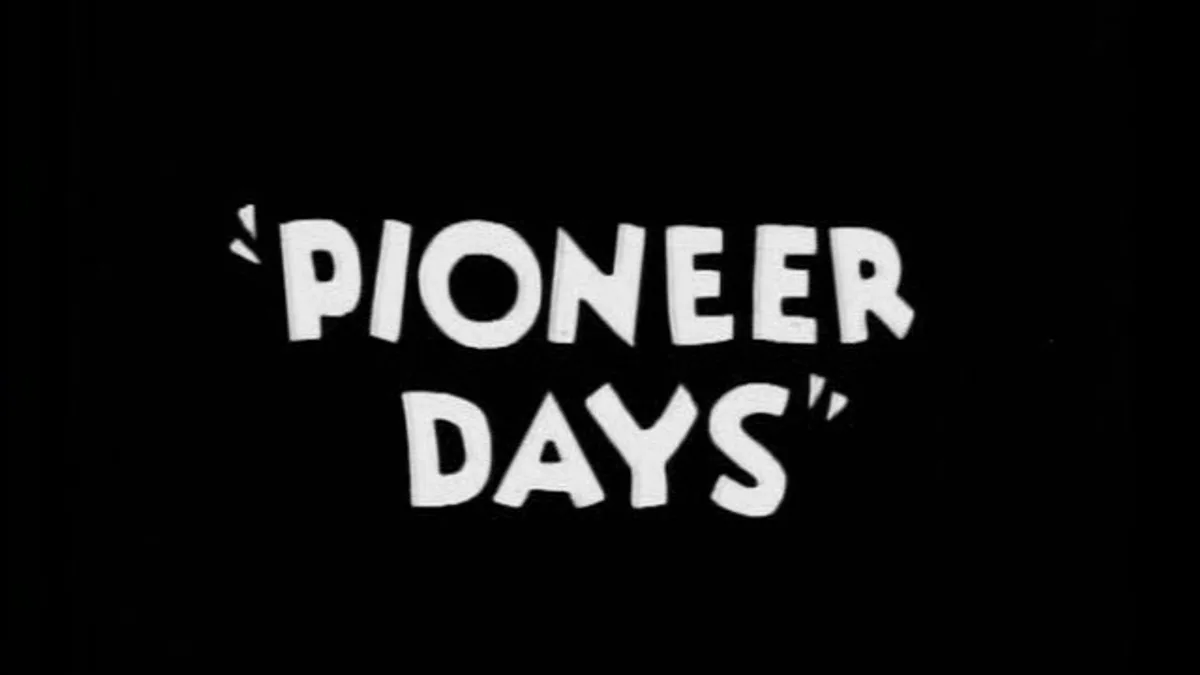
01Start with the songbook
The first half of Pioneer Days is a concert on wheels, and the choice of tunes tells you how the studio thought about the West in 1930. Mickey and Minnie lead a line of covered wagons across the desert with a banjo and Oh! Susanna, which is the obvious pick. The rest of the score is stranger, and more revealing.
- Oh! Susanna, sung by the mice at the head of the wagon train.
- The Streets of Cairo and Khosn kale mazel tov, played as the medley for the war dance around the tribe's campfire: a hoochie-coochie standard and a Yiddish wedding tune standing in for anything remotely Native.
- Darling Nelly Gray, delivered as a mournful solo by an old goat once the settlers have circled the wagons for the night.
- Li'l Liza Jane, performed by a trio at the same camp.
The campfire medley is the giveaway. Nobody at the studio was reaching for authenticity; they were reaching for whatever sounded exotic to a Hollywood ear, and a Middle Eastern novelty tune spliced to a klezmer standard was close enough. That is worth keeping in mind for everything that follows. The film's version of the frontier is assembled entirely from other movies and vaudeville, not from anywhere on a map.
02Three animators, three showpieces
What has kept Pioneer Days in circulation among people who study this period is not the plot but three passages of animation, each attributable to a specific hand.
| Animator | Sequence | Why it mattered |
|---|---|---|
| Norm Ferguson | The dance around the bonfire, with long shadows thrown across the ground | Cast shadows that move with the figures were rare in 1930 cartoons; this is effects thinking before the studio had an effects department |
| Ben Sharpsteen | The attack on the encampment, and a shot taken from the back of a horse circling the wagons | The circling shot keeps a ring of wagons in moving perspective, a camera idea in a medium that mostly staged action flat |
| Wilfred Jackson | The close-up fight between Mickey and the warrior who has carried Minnie off | Two figures grappling in close-up with interlocking movement, a step up from the rubber-hose brawls of 1929 |
Sharpsteen's circling shot is the one to freeze-frame. The wagons keep their spacing and their foreshortening as the point of view swings around them, which means somebody worked the perspective out on paper before a single drawing was made. It is the kind of thing that later became routine with the multiplane camera. Here it was done by hand, in a seven-minute short about a mouse.
Somebody worked out that perspective on paper before a single drawing was made.
03The attack, beat by beat
Mickey has boasted to Minnie that he is not afraid of Indians, so the film's job is to test the claim. The tribe, drawn as wolf-like figures in feathered headdresses carrying tomahawks, has already spotted the caravan. Once the settlers have circled up and sung their songs, the raid begins. The settlers shoot; the attackers loose arrows, several of which hit Mickey in the seat of his trousers without lasting effect. Mickey answers by firing quills from a porcupine, the one purely cartoon weapon in the film.
Then the plot tightens. Minnie is carried off and tied up. Mickey goes after her, and the fight that Jackson animated follows. It is Minnie, not Mickey, who ends it, by dropping a hot coal down her captor's trousers. The mice then march back toward the camp pretending to be a column of reinforcements, the attackers scatter, and the settlers celebrate. It is a neat piece of construction: the boast, the test, the rescue that the rescued party finishes herself, and a bluff to close.
04The ending that went missing for sixty years
For most of its life the film was shown short. The 1940 reissue removed the final scene, in which the settlers frighten off the attackers, and ended instead on Mickey's rescue of Minnie. That trimmed version is the one that went to television and to laserdisc, so several generations knew a Pioneer Days that stops a beat early. The complete original ending was restored for the Walt Disney Treasures DVD, Mickey Mouse in Black and White, released on December 2, 2002.
The cut version is, oddly, the tighter film; the rescue is a natural curtain and the reinforcements bluff is an extra flourish. But the restored version is the record, and the record is what an archive should keep. The DVD also carries a filmed introduction by Leonard Maltin cautioning viewers against judging the cartoon by the standards of some seventy years later, which is the studio's way of acknowledging what the next section is about.
05On the Indians, plainly
The attackers in Pioneer Days are the stock hostiles of the 1920s Western, transferred to animal form with nothing altered: war bonnets, tomahawks, a dance around a fire, a kidnapped heroine. The film did not invent any of it. It borrowed the whole package from the live-action features and serials its audience already knew, and the campfire medley shows how little anyone cared where the package came from. That is a description, not a defence. The portrayal is why the film now travels with a disclaimer, and why it will not be shown to children without one.
Judged as an artifact, which is the only way this archive judges anything, it is an unusually clear specimen of how Hollywood's frontier myth passed straight into animation. Judged as a film, it is a case of superb craft spent on a story that was second-hand before the first drawing was made. Both things are true, and the second does not cancel the first.
06Placement
Released on November 20, 1930 through Columbia Pictures, Pioneer Days was the twenty-fourth Mickey Mouse short and the ninth and last of 1930. Burt Gillett directed; Walt Disney produced and voiced Mickey; Marcellite Garner voiced Minnie. Horace Horsecollar and Clarabelle Cow appear among the settlers without much to do. It followed The Picnic and preceded The Birthday Party in January 1931. Like the rest of the 1930 output, it entered the public domain in the United States on January 1, 2026.
Within Gillett's run it belongs with the action pictures rather than the concerts: closer to The Fire Fighters than to The Shindig. If you want to see what the studio's animators could do at the end of 1930, this is the reel. If you want a Mickey short you can show without a preamble, pick another.
Questions people ask
- When was Pioneer Days released?
- It was released on November 20, 1930 by Columbia Pictures. It was the twenty-fourth Mickey Mouse short produced and the ninth of 1930.
- Who directed Pioneer Days?
- Burt Gillett directed, with Walt Disney producing and voicing Mickey and Marcellite Garner voicing Minnie. Norm Ferguson, Ben Sharpsteen and Wilfred Jackson are credited by historians with its most notable sequences.
- Why do older copies of Pioneer Days end differently?
- The 1940 reissue cut the final scene of the settlers driving off the attackers and ended on Mickey rescuing Minnie. That shortened version circulated on television and laserdisc until the original ending was restored on the 2002 Walt Disney Treasures DVD.
- Does Pioneer Days contain Native American stereotypes?
- Yes. The attackers are drawn as wolf-like figures in war bonnets with tomahawks, following the conventions of 1920s Westerns. The 2002 DVD release includes an introduction by Leonard Maltin addressing this context.
More Mickey Mouse shorts
All shorts →
Sources
Entered September 7, 2026. How this page is sourced: see the sources and method.