01Curtain up on a smaller studio
Context first, because the film cannot be read without it. Ub Iwerks, who had drawn Mickey from the beginning and animated the early shorts nearly single-handed, left the studio in January 1930. Fiddlin' Around, released March 6, 1930, was the first Mickey cartoon made without him. Animation is credited to Les Clark, the young inker Iwerks had trained up, and the picture is in effect a proof of concept. Could the studio still make a Mickey?
The answer chosen was to strip everything else away. No barnyard, no Minnie, no villain, no chase. Curtains part on a stage and Mickey walks out with a violin. The whole short is a recital, and the whole recital is a close-up on one character in front of an audience that is heard and never seen. If the drawing failed, there would be nothing to hide behind.
02Traumerei, and what a mouse's face can do
The programme opens with Schumann's Traumerei, a slow piece, and the choice is shrewd. A fast number would have let the animators cover for themselves with movement. A slow one forces them to act. Mickey closes his eyes, tilts, sways; his mouth softens; the pie-cut eyes narrow and reopen. For the first time in the series the face carries a full minute on its own, and it holds. Contemporary notices praised the expressions and the hands specifically, and the hands are the harder job: fingers on the neck of the instrument, the bow arm, the turning wrist. In the Iwerks shorts hands were mitts. Here they are drawn.
Brahms's Hungarian Dance No. 5 follows, faster, and Mickey plays himself into a state, overcome by his own feeling, and leaves the stage. The unseen audience applauds. He comes back. The transition between the two pieces is worth watching twice: the slow number ends on a held pose, the fast one begins with the whole body already in motion, and the cut between them is where the film shows its timing rather than its drawing.
It also shows how much the studio had absorbed from the concert stage itself. The bows, the exits, the pause before the encore, the exaggerated modesty: these are the manners of a touring virtuoso, observed closely enough to parody. A 1930 audience would have recognised the routine from the newsreels and the Sunday supplements, and the joke is that a mouse has learned it perfectly.
03The encore and the heckler
The encore is the final measure of the William Tell overture, stretched past breaking, and a single voice in the dark laughs at him. The heckler is the film's only antagonist. Mickey plays on, plays harder, and in the process snaps first the violin and then the bow in half, finishing the phrase on whatever is left. It is a stubbornness gag, and a good one, because it turns a musical short into a small drama of nerve.
The heckler is the film's only antagonist, and he never appears.
Then the curtains close and flatten him. The ending is abrupt, almost dismissive, and it saves the film from sentiment. Six and a half minutes of a mouse feeling his music are allowed about one second of pathos before the stage machinery squashes it. That reflex, undercutting the tender moment with a bit of violence, would become a studio habit; this is an early and clean example.
04What changed without Iwerks
- Less rubber. Mickey's limbs still bend, but the body keeps its volume when he sways instead of stretching like hose.
- Held poses. The 1929 shorts rarely stopped moving; here Mickey is allowed to be still long enough for an expression to register.
- Hands as actors. Finger positions on the strings are drawn, not smeared through.
- A single set. With no cut to a second location, the timing had to live on the character rather than the scene change.
None of this made Clark a better animator than Iwerks in 1930; he was not, and the film has stretches where the pace goes slack. But it shows a different priority taking hold, one that would define the studio's next decade: personality first, movement in its service. Fiddlin' Around is the earliest Mickey in which that ordering is unmistakable, and it is no accident that it arrived the moment the man who prized movement above all had gone.
05Two titles for one film
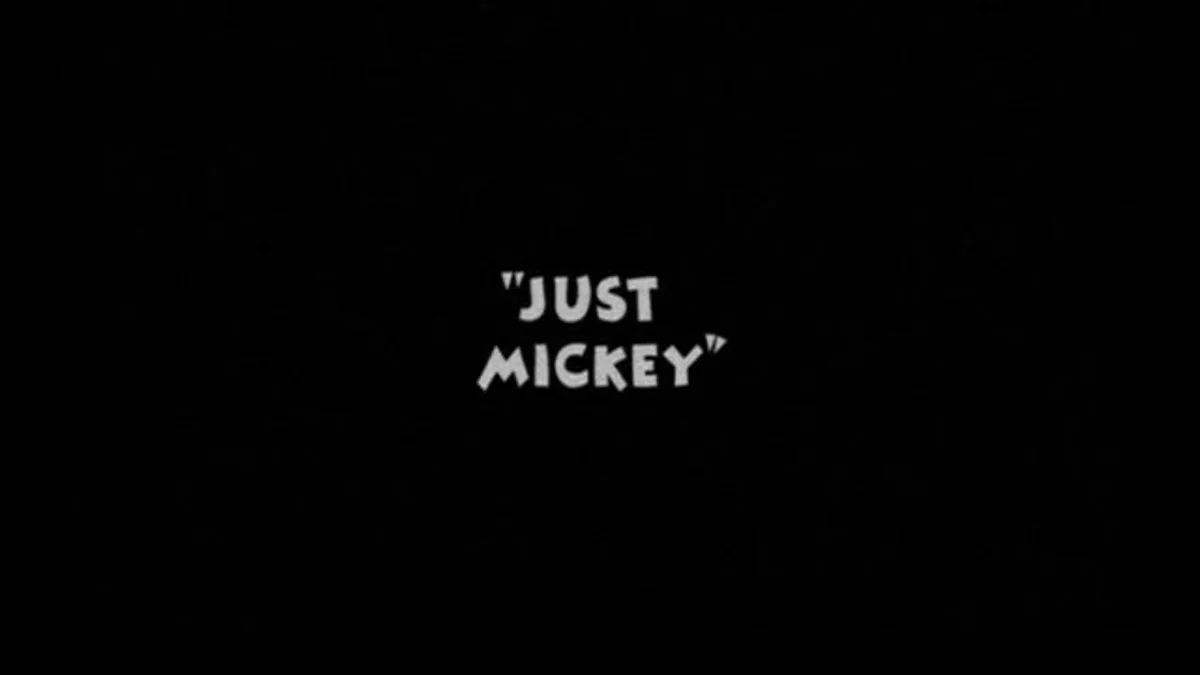
The short circulated as Just Mickey as well as Fiddlin' Around, and for years the shorter name was the one collectors and reference books used. Wikipedia treats Just Mickey as the likely working title and Fiddlin' Around as the release title. Both are honest descriptions. It is just Mickey; he is fiddling around. The doubled name is a small reminder that the studio's paperwork in 1930 was thinner than its output, and that the record of these films was reconstructed long after the fact from whatever prints and press books survived.
The apostrophe in the title is not decoration either. Fiddlin' Around, dropped g and all, is a colloquial shrug, the kind of title a vaudeville act might carry on a lobby card, and it sits oddly against the Schumann and Brahms on the programme. That gap is the whole joke of the film in three words: high repertoire, low manners, and a performer who takes the music seriously while the picture takes him not seriously at all.
06Sixteenth in the series, first of the year
Wikipedia counts Fiddlin' Around as the sixteenth Mickey Mouse short and the first of 1930, distributed by Columbia Pictures and running 6:50. It reached Disney+ in October 2023 and entered the United States public domain on January 1, 2026.
It is a minor film that matters. As entertainment it is a pleasant recital with one good joke and a brutal curtain. As evidence it is the moment the Mickey series survived losing the man who drew it, and did so by betting on the face rather than the gag. Three reels, and the third is for the hands.
Questions people ask
- When was Fiddlin' Around released?
- It was released on March 6, 1930, through Columbia Pictures. Wikipedia lists it as the sixteenth Mickey Mouse short and the first released in 1930.
- Why is Fiddlin' Around also called Just Mickey?
- The short circulated under both names. Just Mickey appears to have been a working title, while Fiddlin' Around is treated as the official release title.
- Why is Fiddlin' Around significant in Disney history?
- It was the first Mickey Mouse cartoon not animated by Ub Iwerks, who left the studio in January 1930. Animation is credited to Les Clark, and the short is often cited for its expressive facial and hand animation.
- What music does Mickey play in Fiddlin' Around?
- He performs Schumann's Traumerei and Brahms's Hungarian Dance No. 5, then returns for an encore built on the last measure of the William Tell overture.
More Mickey Mouse shorts
All shorts →
Sources
Entered September 7, 2026. How this page is sourced: see the sources and method.