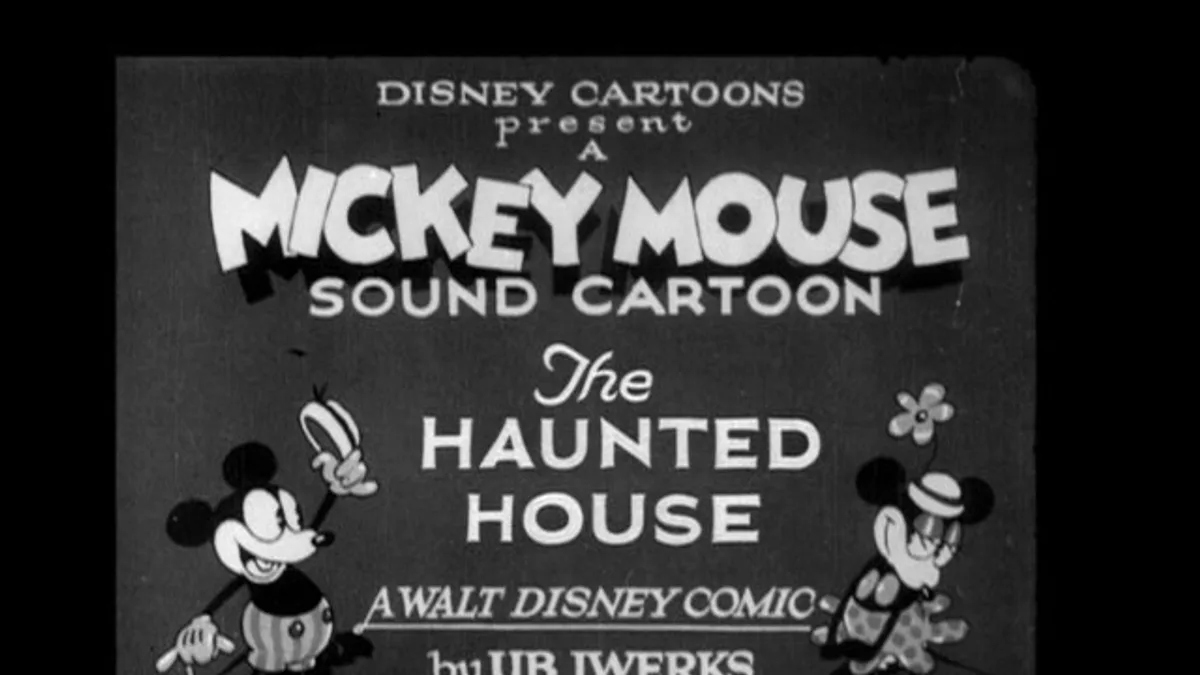
01Rain, a porch, and a door that locks itself
The first minute is the best minute. Rain lashes a crooked house, lightning cuts across the frame, and Mickey, drenched and very small, hammers on a porch door that answers by dropping the entire porch on him. He edges inside, the door swings shut and locks by itself, and the film has its mood in place before a single skeleton has shown up. The 1929 studio rarely bothered with atmosphere for its own sake. Here it did, and the difference is plain: the blacks are heavy, the shadows have weight, and the cutting holds back long enough for the dread to accumulate.
Then the house goes to work on him. Bats pour out of holes in the wall. A spider lowers itself from the ceiling and Mickey dives into a chamber pot, which is a joke and also, as it turned out, a problem. The chandelier dies, he strikes a match, and a hooded shadow rises behind his own on the wall. Trade reviewers of the day singled out this opening, and they were right to. It is a tighter stretch of suspense than anything in the Mickey series up to that point, and it would be several years before the studio bettered it.
02Skeletons on loan
The hooded figure drops its cowl and is a skeleton. From here the picture changes register, and the reason is a matter of record: The Haunted House reuses animation from The Skeleton Dance, the first Silly Symphony, released earlier the same year. That film had been a genuine sensation, and a studio turning out a Mickey roughly every month had every incentive to get a second run out of its most admired footage. The bone-dancers are lifted more or less intact, re-staged in a parlour, and handed a new pretext. They want music, and Mickey is made to supply it.
So the mouse sits at an organ and plays while the dead dance. One skeleton works a radiator like an accordion, the kind of object-substitution gag Ub Iwerks could draw in his sleep. It is also the point where the short stops being Mickey's film. He is a hired accompanist for somebody else's number, and once you see it that way the middle stretch reads less like a horror comedy than a variety act with a rhythm section of femurs. The historian Gijs Grob made essentially this complaint, and it is hard to argue with.
For two minutes Mickey is a hired accompanist for somebody else's number.
03What the censors counted
Two gags got the film into difficulty with state censor boards: the chamber pot and the outhouse. Both are toilet jokes in the literal sense, and both are staged with more relish than the studio would permit itself a few years later. The outhouse is the closer. Mickey, fleeing, yanks at its door hoping to hide, and a skeleton seated inside slams it in his face. The film ends with him running, still screaming, back out into the rain.
A third gag would give a modern board more pause. Somewhere in the panic Mickey shouts a burlesque of Al Jolson's 'Mammy' line. The trade press loved it; Motion Picture News called the Jolson bit 'a darb'. It is a period impersonation of a blackface performer, and it belongs in the same drawer as the title pun of The Jazz Fool two months earlier. The studio was addressing a 1929 adult audience that had seen the Jolson pictures and expected the wink.
04The question of the credit
Wikipedia lists Jack King as director and calls this the first film he directed. The screen credit of the period, on this short as on every Mickey around it, named Walt Disney and nobody else, and the Wikidata record still gives Disney. The discrepancy is worth keeping in view rather than forcing to a resolution. Direction at the 1929 studio was a loose job, split between Walt's story sessions, Iwerks's key animation and whoever timed the exposure sheets. That a King credit can be argued for at all tells you the operation had begun to delegate.
If King did run the picture, the atmospheric opening is a fair sample of what he brought: a willingness to let a scene breathe before the gags arrive. The same instinct shows up years later in the Donald Duck shorts he directed, where the slow burn before the explosion is the entire method.
05Inventory of frights
- A collapsing porch, the film's first and cleanest piece of slapstick timing.
- Bats from the wall, a spider from the ceiling, a chamber pot as refuge.
- A hooded shadow growing behind Mickey's own before the reveal.
- The organ recital with skeleton dancers, footage shared with The Skeleton Dance.
- A doorknob that is a bony hand and shakes him like a rattle.
- Two skeletons already in bed upstairs; a barrel of them below the window.
- The occupied outhouse.
Laid out like that, it is a dark ride rather than a story: a sequence of rooms, each with one trick. That is a description of the form, not a complaint about it. Ride cartoons work when the tricks escalate, and these mostly do, until the recital stalls the momentum in the middle and the film has to restart its own chase.
06Fourteenth of the run, and now anyone's
The Haunted House was the fourteenth Mickey Mouse short and the eleventh released in 1929 alone, arriving on December 2 through Celebrity Productions and later reissued by Columbia. Variety, in February 1930, called it 'delightfully mad'. Since January 1, 2025 it has been in the American public domain, which means the borrowed skeletons are now free to be borrowed again.
Seen today it splits cleanly into a very good opening, a padded middle, and a rude, effective close. The studio returned to the haunted-house template in The Gorilla Mystery the following year and, with real ambition, in The Mad Doctor in 1933. This is the sketch for those. It is scarier than it is funny, which in December 1929 was itself a small novelty.
Questions people ask
- When was The Haunted House released?
- It was released on December 2, 1929, distributed by Celebrity Productions. It was the fourteenth Mickey Mouse short and the eleventh released during 1929.
- Who directed The Haunted House?
- Wikipedia credits Jack King as director and notes it was the first film he directed, with animation by Ub Iwerks and music by Carl Stalling. Screen credits of the period named only Walt Disney, and some databases still list him as director.
- Is The Haunted House connected to The Skeleton Dance?
- Yes. The short reuses animation from The Skeleton Dance, the first Silly Symphony, which was released earlier in 1929. The skeleton dancers are re-staged around Mickey at the organ.
- Is The Haunted House in the public domain?
- Yes. As a work published in 1929, it entered the United States public domain on January 1, 2025.
More Mickey Mouse shorts
All shorts →
Sources
- The Haunted House (1929 film) — Wikipedia
- The Skeleton Dance — Wikipedia
- Mickey Mouse (film series) — Wikipedia
Entered September 7, 2026. How this page is sourced: see the sources and method.