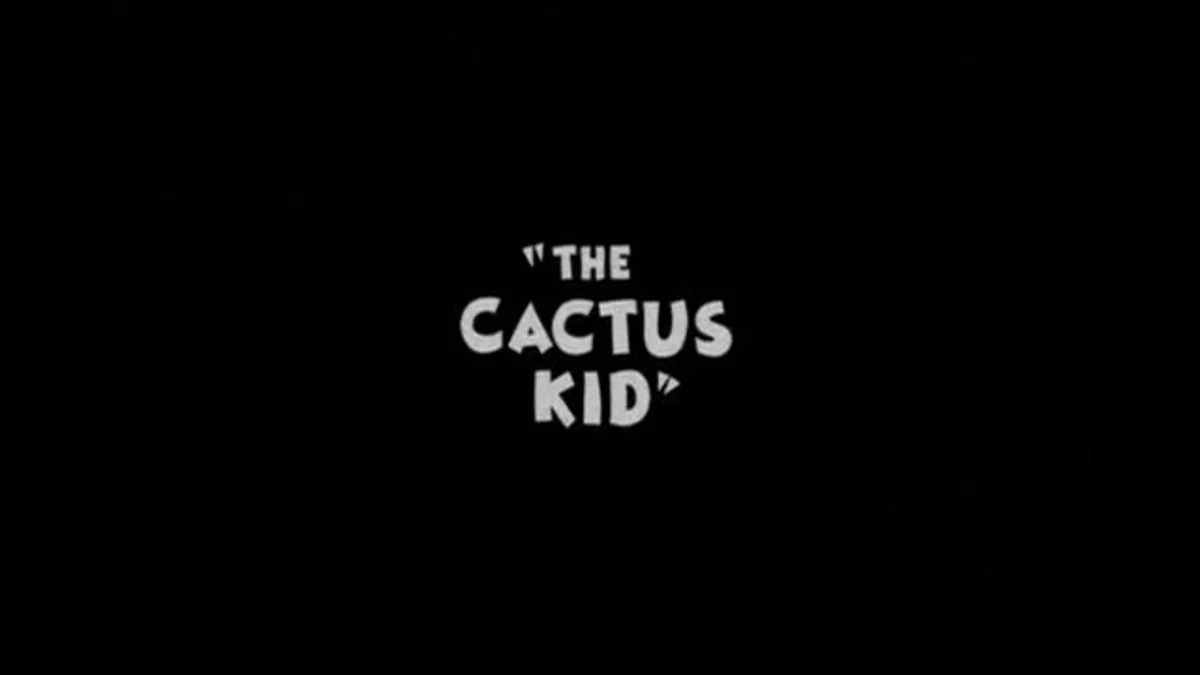
01Same story, new border
The Cactus Kid does not hide its ancestry. In 1928 The Gallopin' Gaucho had put Mickey in a South American cantina, given Minnie a job there, and let Pete carry her off for a chase. Two years later the studio moved the same plot to Mexico, swapped the ostrich for a horse, and shot it again. A remake this early in a character's life looks odd until you remember the production rhythm: one short a month, a small crew, and no story department yet. Proven material was money in the bank.
What the second telling has that the first lacked is polish. Mickey rides up on horseback, finds Minnie waitressing, dances, plays the spoons, tweaks her nose and gets pelted with crockery for it, then wins her back with some clowning and a turn at the piano. It is barnyard courtship transplanted to a saloon, and it plays, partly because Minnie now answers back in a voice of her own.
02Drawings fitted to a track
The technical claim in the record is the interesting one. Wikipedia reports that on this short the animators for the first time matched their action to a prerecorded soundtrack, and that synchronisation improved as a result. The choice of music makes the difference audible: Chabrier's Espana for the cantina, La paloma for the romance, and Offenbach's can-can driving the chase. The can-can in particular is a stress test. Its tempo does not forgive a late frame, and the pursuit across the desert keeps time with it.
The can-can does not forgive a late frame, and the chase keeps time with it.
Whether the method was genuinely new to this film or simply first documented here, the result is the tightest fit of music to picture in the series to that date, and it is why the film feels quicker than its 7:25 runtime. The gunfight in the dark, with the lights snapping off and the shots landing as sound alone, is a gag that only works if the track leads.
03The ledger
| Item | Detail |
|---|---|
| Minnie's voice | Marcellite Garner's debut as Minnie Mouse; she kept the role until 1941 |
| Pete's peg leg | First Mickey cartoon in which Pete, here billed as Peg-Leg Pedro, has the peg |
| Walt Disney directing | His last directing credit on a Mickey short until The Golden Touch in 1935 |
| Horace Horsecollar | Present in his bowler hat but still behaving as a horse; fully upright by The Shindig later in 1930 |
| Series position | Eighteenth Mickey Mouse short, third of 1930 |
Read as a ledger, the film is a hinge. The studio that made it still had Walt in the director's chair and a horse that had not yet learned to walk on two legs. The studio it was turning into had a voice actress with an eleven-year run ahead of her and a villain silhouette the animators would lean on for years.
04Pedro, and the gun that was an umbrella
The villain is Pete under a Mexican alias, Peg-Leg Pedro, and the peg is new. He enters the cantina, seizes Minnie by the arm, demands a kiss, and gets Mickey instead. The two draw on each other, the lights go out, and when they come back Pedro is gone with Minnie slung over his donkey. One gag in this stretch came straight from the newspaper: Mickey drawing an umbrella where a pistol should be, recycled from the Mickey Mouse comic strip of April 23, 1930, seventeen days before the film's release. The strip and the screen were feeding each other in something close to real time.
Pete had been around since the Oswald days and had already faced Mickey in Steamboat Willie, but the peg is what fixed him. It gave the animators a rhythm to draw, a clunk for the sound track, and a shorthand for menace the studio would keep for years.
05A chase borrowed from a rabbit
The pursuit is where the reuse shows. Mickey's horse drags him through a cactus, and part of the sequence was lifted from Sagebrush Sadie, a 1928 Oswald the Lucky Rabbit cartoon the studio had made for Universal before losing the character. Nobody in 1930 could have checked; Oswald belonged to someone else and the old reels were not circulating. Watched now, the borrowing is a reminder that Oswald and Mickey were one continuous workshop, and that a good deal of what reads as early Mickey invention was Oswald invention with rounder ears.
The ending is blunt. Mickey catches Pedro, punches him, Pedro goes over a cliff and a boulder flattens him, and Mickey, Minnie and the horse wave down at the result. Trade reviewers were pleased. Variety called it 'a pip', The Film Daily found the sound and animation well blended, and Motion Picture News judged the laugh count sufficient. None of them mentioned that they had seen the plot before.
06Where Walt stepped back
Released May 10, 1930 through Columbia Pictures, The Cactus Kid was the eighteenth Mickey Mouse short and the third of the year, animated by Norm Ferguson, and the last one Walt Disney directed for five years. From here the directing credit passed to other hands while Walt concentrated on story, which is where his real contribution had lived all along. The film has been in the United States public domain since January 1, 2026.
Judged as a film, it is a competent western burlesque with a good chase and a thin middle. Judged as a document, it is one of the busiest single reels in the early series: a new voice, a new leg, a new way of scoring, and a founder quietly leaving the chair. Three reels, leaning toward four on the strength of the ledger.
Questions people ask
- When was The Cactus Kid released?
- It was released on May 10, 1930, by Columbia Pictures. It was the eighteenth Mickey Mouse short produced and the third released in 1930.
- Who voiced Minnie Mouse in The Cactus Kid?
- Marcellite Garner, making her first appearance as the voice of Minnie. She continued in the role until 1941. Walt Disney voiced Mickey.
- Is The Cactus Kid the first cartoon where Pete has a peg leg?
- It is the first Mickey Mouse cartoon in which Pete, appearing here as Peg-Leg Pedro, is shown with a peg leg.
- Was The Cactus Kid really the last short Walt Disney directed?
- It was his last directing credit for five years. He did not direct again until The Golden Touch in 1935.
More Mickey Mouse shorts
All shorts →
Sources
Entered September 7, 2026. How this page is sourced: see the sources and method.