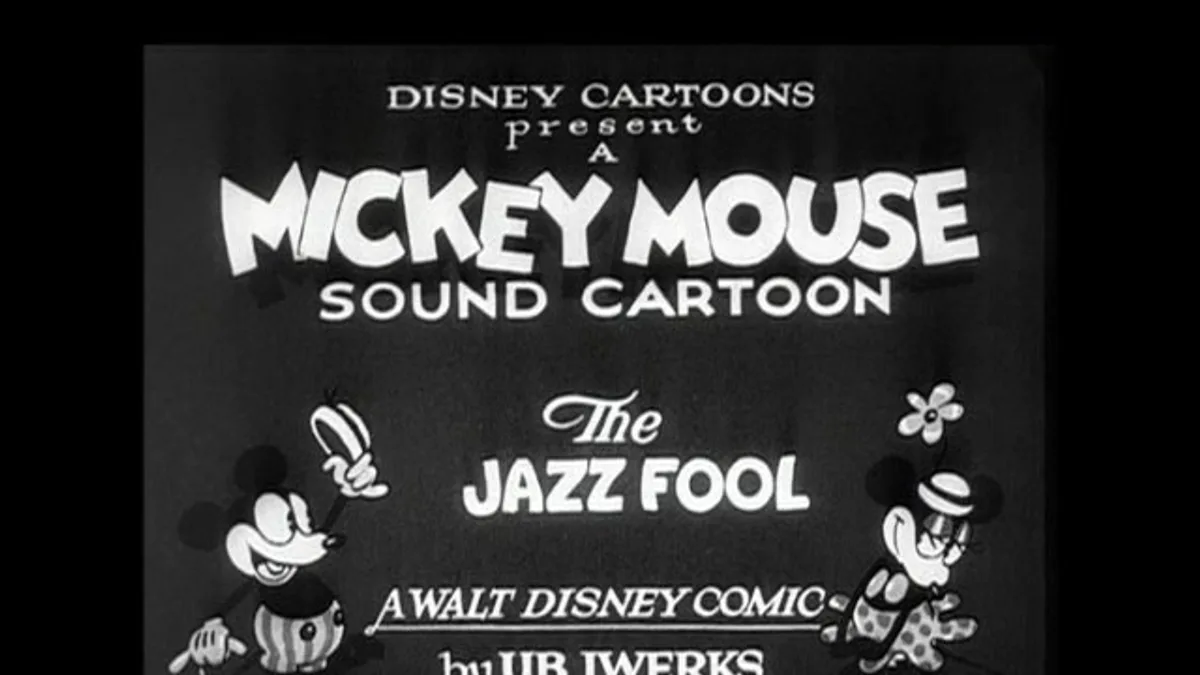
01A road show with an audience of one
The Jazz Fool opens with Mickey pulling into a fairground on a rickety wagon, an organ strapped to the back and a horse doing the pulling. Within a minute he has set up, gathered a barnyard crowd, and started playing. That is the whole premise. There is no villain, no rescue, no chase — the short is built entirely around the act of performing, and the animators seem to have decided early that the music was the story.
It helps to remember what audiences of late 1929 were hearing for the first time. Synchronized sound was barely two years old, and the novelty of watching a drawn character keep time with a soundtrack had not yet worn off. Carl Stalling's score does most of the heavy lifting, and the cartoon is content to let Mickey mug, sway, and hammer the keys while the animals in front of him bob along. Judged as a narrative, it is thin. Judged as a two-minute music video made in 1929, it is doing something the medium could barely do at all.
02The piano fights back
The best stretch arrives late, when the piano stops cooperating. Mickey leans into an aggressive solo, the instrument bucks and snaps at him, and the two end up in a brief boxing match that the piano wins by biting him. It is a small idea, but the animation sells it: the keyboard becomes a mouth, the lid a jaw, and Mickey's exasperation reads clearly in a few economical poses.
The keyboard becomes a mouth, the lid a jaw, and Mickey's whole mood reads in a few poses.
This is the kind of gag the studio would refine for years — an ordinary object turning hostile and forcing the star to react. Here it is rough, but you can see the instinct that later produced the great Donald Duck property-comedies. The interest is less in the joke than in how much personality the artists could squeeze out of Mickey with the limited toolkit of 1929: rubber-hose limbs, pie-cut eyes, and a face that had not yet settled into its familiar proportions.
03Built from spare parts
The Jazz Fool was not made from scratch. It reprises the piano-concert idea from The Opry House, released seven months earlier in March 1929, and lifts several gags wholesale. Reuse like this was normal at the young studio, where a small crew turned out a Mickey short roughly once a month and leaned on proven material to keep the schedule. Watching the two side by side is a useful lesson in how the shorts were actually manufactured: less a run of original ideas than a set of reliable bits, reshuffled and re-timed.
An early version of Horace Horsecollar appears here as the wagon horse, still closer to a real animal than the walking, talking character he would become. These transitional designs are part of what makes the 1929 shorts worth returning to. The cast was being assembled in public, one cartoon at a time, and you can watch the supporting players harden from generic barnyard extras into recognizable figures.
04A title on loan from Al Jolson
The name is a pun stitched from two of the biggest pictures of the moment: Al Jolson's The Jazz Singer (1927) and The Singing Fool (1928). The joke would have landed instantly in 1929 and lands not at all today, which is its own kind of historical marker. The short has nothing to do with either film beyond the wink; the studio simply borrowed the glamour of a topical title, the way a novelty record might.
It is a reminder that these cartoons were commercial products chasing the same audience as live-action features, not children's programming in the later sense. The humor assumes you follow the movies, read the marquees, and get the reference.
05Where it sits in the run
By release order this was the twelfth Mickey short and the ninth to arrive in 1929 alone — a punishing pace that explains both the recycling and the occasional flatness. It belongs to the stretch just after sound had been cracked and just before the studio began treating each film as a chance to try something structurally new. The Jazz Fool is a holding pattern, but a confident one.
If you are working through the 1929 Mickeys in sequence, treat this as a companion piece to The Opry House rather than a standalone. On its own it is minor. As a data point in a very fast year of trial and error, it earns its place.
Questions people ask
- When was The Jazz Fool released?
- It premiered on October 15, 1929, making it the twelfth entry in the Mickey Mouse series and the ninth Mickey short released during 1929.
- Who directed The Jazz Fool?
- Walt Disney is credited as director, with a musical score by Carl Stalling. It was produced at the Disney studio and distributed by Celebrity Pictures.
- Why does the title reference Al Jolson?
- The name blends two Al Jolson hits, The Jazz Singer (1927) and The Singing Fool (1928). It was a topical pun aimed at 1929 moviegoers; the short itself is unrelated to those films.
- Is The Jazz Fool connected to The Opry House?
- Yes. It revisits the piano-concert premise of The Opry House (March 1929) and reuses several of its gags, a common practice at the studio during its high-output early period.
More Mickey Mouse shorts
All shorts →
Sources
Entered September 7, 2026. How this page is sourced: see the sources and method.