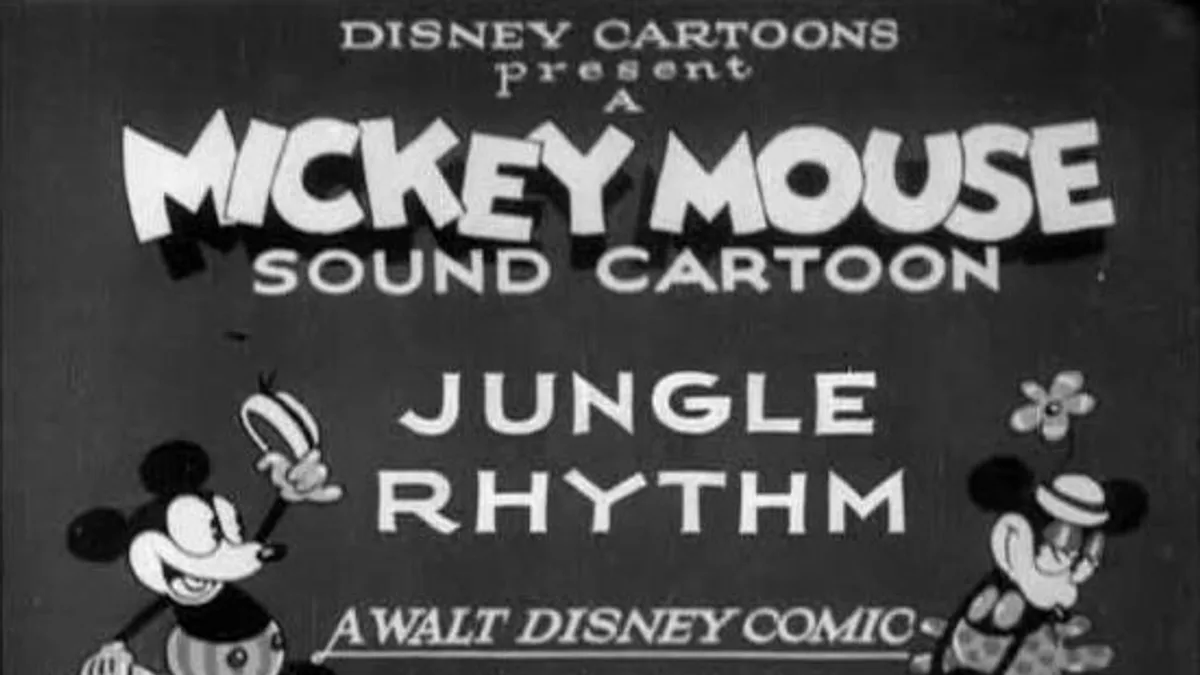
01The programme
Better to start with the music, since the film has nothing else to organise itself around. Carl Stalling's score threads a run of old standards through the animals' dance numbers, and the choice of tunes says a good deal about who the studio thought was in the seats.
| Piece | Origin | Note |
|---|---|---|
| The Blue Danube | Johann Strauss II, 1866 | The ballroom number |
| Auld Lang Syne | Scottish, words by Robert Burns | The sentimental spot |
| Aloha 'Oe | Composed by Queen Liliuokalani of Hawaii | The novelty spot, and the censors' problem |
| Turkey in the Straw | American folk tune | Already used in Steamboat Willie the year before |
| Yankee Doodle | American, 18th century | The march |
Two things stand out. Every piece was free to use, which mattered to a studio paying for sound recording on a thin margin. And the mix is a vaudeville bill in miniature: a waltz for the ballroom set, a folk stomp for the barn, a Hawaiian number for the novelty turn. The jungle is a pretext for a revue.
02A bandleader, not a hero
The set-up takes under a minute. Mickey wanders in among elephants, monkeys and lions; a monkey and a parrot get hold of his accordion and start playing; the animals take that as their cue. From then on Mickey is master of ceremonies, dancing with whatever creature the next tune calls for and taking a bow at the close while an audience of animals applauds. There is no threat, no chase, no Minnie to rescue. The film is one continuous number, and the only structure it has is the order of the tunes.
The animals are the real cast. Each gets a turn shaped to its body: the elephants are all weight and bounce, the monkeys are quick and rubbery, the lions swagger. Mickey adjusts to each partner in turn, and those adjustments, more than anything he does alone, are where the character work lives. He is a straight man to a jungle.
Whether that works depends on your appetite for early sound-era dancing. Gijs Grob dismissed it as among the dullest of the early Mickeys, and on plot grounds he is plainly right. Ryan Kilpatrick defended the dance sequences and the flow of the drawing, and on craft grounds he has a case. Both are describing the same object: Iwerks-era animation at its most fluid, spent on a structure that gives it nowhere to go. Jungle Rhythm came out exactly one month after The Jazz Fool and shares its weakness. The music is the story, and the music, however well timed, cannot generate a second act.
The music is the story, and the music cannot generate a second act.
03The lion that worried the censors
The one moment anyone remembers is the hula. A lion swings its hips to Aloha 'Oe, and state censor boards objected. Wikipedia records that the studio had trouble with the censors over the lion's suggestive dancing, which puts a jungle cat in the same file as the chamber pot that caused complaints in The Haunted House a month later.
It is hard to see the offence now, and that is the point. Censor boards in 1929 were alert to any trace of a burlesque routine in a picture that might play to children on a Saturday afternoon, and a hula was code for exactly that. The complaint says less about the cartoon than about the year. What it does confirm is that the studio was not drawing for children in the later sense. It was drawing for a general audience that got the joke, and the joke was mildly blue.
04Two hands on the pencil
The animation credit is shared between Ub Iwerks and Ben Sharpsteen, which makes this one of the last Mickeys to carry Iwerks's name. He left the studio in January 1930, two months after this release, and from Fiddlin' Around onward the series was drawn without him. Which scenes belong to which hand is not on the record, and the film does not announce it. What is visible is the house style at its most settled: elastic animal bodies, clean cycles, a dance line that stays in step with the track. Sharpsteen, who would later run production for the studio, was already part of that machine.
Watched with the departure in mind, Jungle Rhythm is a document of a system working smoothly right before it lost its founder animator. Nothing in it is difficult; everything in it is competent. That is the sound of a studio that had learned its craft and not yet learned what to do with it.
05Where it went afterwards
The short had an odd afterlife for something so slight. It supplied the premise for the first adventure storyline in the Mickey Mouse newspaper strip in 1930, which means the jungle, not the barnyard, was the first place the comic-strip Mickey went looking for trouble. Eight decades on it surfaced again as a 'Projector Screen' level in the 2010 Wii game Epic Mickey, one of the early shorts the game used as connecting passages between its larger worlds.
Both uses point at the same thing. The setting is more memorable than the film. A mouse with an accordion in a jungle is an image; the six and a half minutes around it are a set list.
06Position and verdict
Thirteenth Mickey Mouse short, tenth of 1929, released November 15 through Celebrity Productions and later reissued by Columbia, running 6:53. It arrived in the studio's most crowded stretch, wedged between The Jazz Fool and The Haunted House, and it is the weakest of the three because it is the one with no idea beyond the format.
That said, the drawing is never less than assured, the animals are individually well observed, and anyone studying how the 1929 unit timed movement to a beat will find a clean specimen here. It is a rehearsal reel with a lion in it. Two reels, and the second one is for the lion.
Questions people ask
- When was Jungle Rhythm released?
- It was released on November 15, 1929, by Celebrity Productions, and later reissued by Columbia Pictures. It was the thirteenth Mickey Mouse short and the tenth released in 1929.
- Who directed and animated Jungle Rhythm?
- Walt Disney directed. Animation is credited to Ub Iwerks and Ben Sharpsteen, with music by Carl W. Stalling. It was among the last Mickey shorts made before Iwerks left the studio in January 1930.
- Did Jungle Rhythm have any censorship problems?
- Yes. Wikipedia notes that Disney had trouble with state censors over the short's suggestive hula-dancing lion.
- Did Jungle Rhythm influence the Mickey Mouse comic strip?
- It did. The short was the inspiration for the first adventure storyline in the 1930 Mickey Mouse newspaper strip. It also appears as a Projector Screen level in the 2010 video game Epic Mickey.
More Mickey Mouse shorts
All shorts →
Sources
Entered September 7, 2026. How this page is sourced: see the sources and method.