01The scene they cut
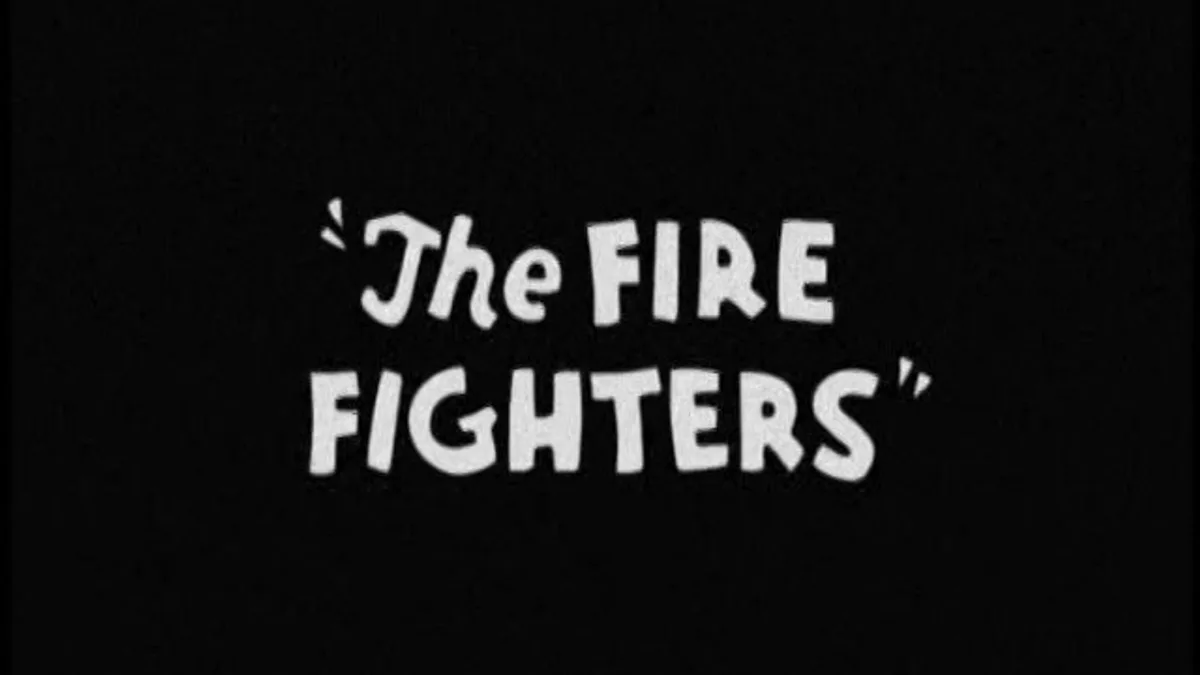
The most telling decision in The Fire Fighters is one you cannot see. The original outline opened with Mickey playing music in the firehouse before the alarm rang, which is exactly how nearly every Mickey short of 1929 and early 1930 had opened: find the star, hand him an instrument, let the barnyard dance. The finished cartoon throws that out. It begins with the whole crew asleep, and the first thing that happens is the bell.
That is a small structural choice with a large effect. By 1930 the studio had made nearly twenty Mickeys, most of them concerts with a thin excuse for a setting. Here the reflex was resisted. The music arrives later, on the road, where it belongs, and the opening minute is spent on something the series had mostly ignored: a situation that has to be resolved.
02Firehouse to fire, in order
The story runs in a straight line, which sounds like faint praise until you compare it with the shorts on either side of it. The load-bearing beats are these:
- Mickey, Horace Horsecollar and a crew of animal firemen sleep in the firehouse until the alarm sounds.
- Everyone dresses in a scramble and the engine rolls out.
- The ride to the fire is scored to There'll Be a Hot Time in the Old Town Tonight, the 1896 ragtime hit, played and sung by the crew as they go.
- The fire is in an apartment building, and Minnie is trapped on an upper floor.
- She faints; Mickey gets her down by way of a clothesline.
- She comes round on the way to the ground, recognises who saved her, and the two sing each other's names, kiss, and the picture irises out.
Nothing in that list is a musical number for its own sake. The song is there because a fire crew going to a fire in 1930 would sing that song; the gags on the way are there because a fire engine full of animals is an obvious place for gags. The film has a spine, and everything hangs off it.
03A rescue Disney had staged before
The plot was not new to the studio. In Alice the Fire Fighter, released on October 18, 1926 as one of the Alice Comedies, Julius the Cat rushes to save Alice from a burning building, and the storyline is essentially the same. What changed between 1926 and 1930 was the medium's reach. Alice was a live-action child pasted into a drawn world, so the rescue could only be so physical. Mickey and Minnie are both drawings, which meant the clothesline, the faint, the descent and the embrace could all be animated with the same freedom.
The studio would come back a third time, with Mickey's Fire Brigade in 1935, by then in colour and with Donald and Goofy along. Watching the three in sequence is a short course in how much the same premise could grow once the tools caught up with the idea. The Fire Fighters is the middle term, and the one where the idea first fit the tools.
04Gillett's run begins
Burt Gillett had joined the studio in April 1929 and had directed before, but The Fire Fighters is the point at which he became the house director for the Mickey series. The Cactus Kid, a month earlier, still carries Walt Disney's name as director. From this film on, through The Shindig, The Chain Gang, The Gorilla Mystery, The Picnic and Pioneer Days, every Mickey release of 1930 is Gillett's, and the pattern continues into 1931.
It is tempting to read the change of approach into the change of chair, and there is something to it. Gillett's Mickeys of this stretch are more interested in incident than in rhythm; they tend to have a problem in the first minute and a solution in the last. The Fire Fighters is the cleanest early example. Whether that was Gillett's instinct or Walt's decision, freed from the director's desk to think about story, the article does not say, and it would be a guess to claim either.
A problem in the first minute, a solution in the last. That is the whole reform.
05Minnie is the point of the exercise
Marcellite Garner voices Minnie, and for once she has something to do besides applaud. She is the reason the engine leaves the station and the reason the film has an ending. The rescue itself is played straight. Minnie passes out, Mickey improvises with a clothesline, and the descent is treated as a danger rather than a dance. When she comes to and realises who has her, the payoff is a duet of names and a kiss under the iris.
One writer has framed Mickey here as a lovable loser in a new role, and it is true that he is small and out of his depth against a building on fire. But he wins, and cleanly, and the film gives him the victory without irony. The Mickey of the concerts was a showman. The Mickey of The Fire Fighters is a small person who does the necessary thing. That is the version the studio would spend the rest of the decade refining, and it appears here almost fully formed.
06Standing, then and since
The trade press liked it. Motion Picture News told exhibitors the laughs came thick and fast and used it as evidence that the Mickey comedies were keeping their lead in the field. Later writers have gone further: one calls it the first Mickey since The Gallopin' Gaucho to tell a straightforward story, and Mickey's best short of 1930. On the second point I would put Pioneer Days close behind for its animation, but as a complete film this one holds up better.
It was released on June 20, 1930, the nineteenth Mickey short and the fourth of that year, distributed by Columbia. It later ran on The Mickey Mouse Club in the 1950s and reached DVD on December 2, 2002 on the first black-and-white Mickey volume of the Walt Disney Treasures series. On January 1, 2026 it entered the public domain in the United States, so it can now be studied, screened and quoted without asking anyone's leave, which for a film this compact and this well built is the right outcome.
Questions people ask
- When was The Fire Fighters released?
- It was released on June 20, 1930 by Columbia Pictures. It was the nineteenth Mickey Mouse short produced and the fourth of 1930, preceded by The Cactus Kid and followed by The Shindig.
- Who directed The Fire Fighters?
- Burt Gillett directed, with Walt Disney producing and voicing Mickey. Marcellite Garner voiced Minnie Mouse.
- Is The Fire Fighters based on an earlier Disney cartoon?
- Yes. Its storyline closely follows Alice the Fire Fighter (1926), an Alice Comedy in which Julius the Cat rescues Alice from a burning building. Disney revisited the premise again in Mickey's Fire Brigade (1935).
- Is The Fire Fighters in the public domain?
- Yes. Because it was published in 1930, it entered the public domain in the United States on January 1, 2026.
More Mickey Mouse shorts
All shorts →
Sources
Entered September 7, 2026. How this page is sourced: see the sources and method.